
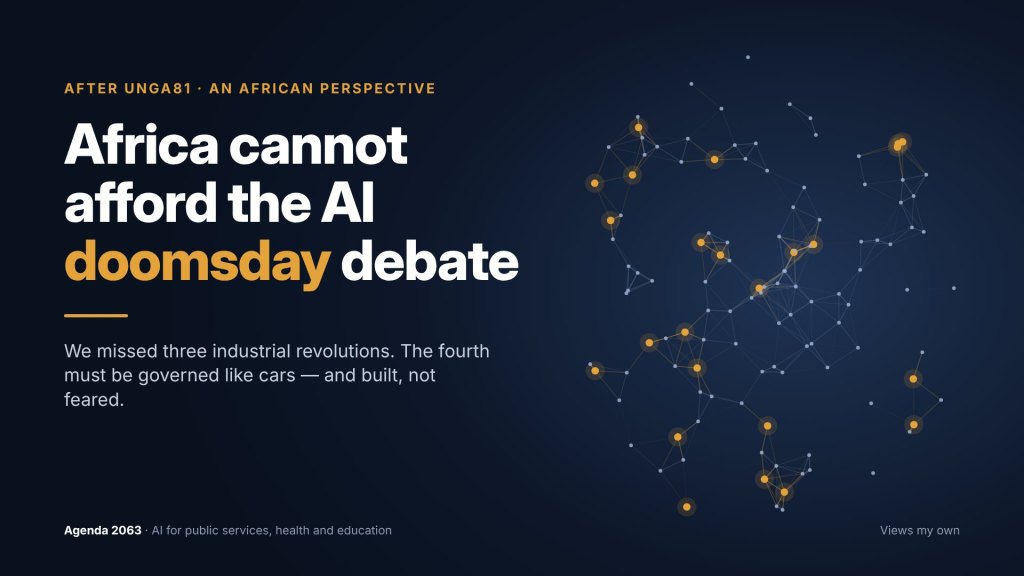
AI Global Economy · Opinion · UNGA81, New York, September 2026
Why Africa must govern AI the way the world learned to govern cars — and build with it, rather than fear it.
By Dr Kudakwashe Dandajena, Ph.D., Principal Programme Officer, Technology Strategy, African Union Development Agency (AUDA-NEPAD)
KEY TAKEAWAYS
- At UNGA81, the UN Secretary-General named artificial intelligence as one of four great tests of power facing the world.
- Africa holds about 18% of the world’s people but under 1% of global data centre capacity and about 2% of manufacturing output.
- History shows that dangerous technologies — cars, trains, lifts — were made safe through rules, not abandoned.
- Africa’s real AI risk is exclusion: weak public, health, education and digital systems that AI should help fix.
- Five priorities can move Africa from declarations to working AI systems that deliver on Agenda 2063.
01 · The view from UNGA81
Africa’s AI debate should be about building, not fearing. A continent that missed most of the gains of earlier industrial revolutions cannot afford to spend this one arguing about extinction.
At the 81st session of the UN General Assembly (UNGA81) in New York, AUDA-NEPAD hosted a series of strategic engagements, including Presidential dialogues and other high-level sessions. Across these rooms, one question kept returning: what does artificial intelligence mean for Africa’s development, and who gets to decide?
On 23 September 2026, UN Secretary-General António Guterres opened the General Debate by describing four great tests of power facing the world: war and peace, inequality, climate change, and artificial intelligence.1 His message was that the power of law must prevail over the law of power. On AI, he was direct: “life-and-death decisions must never be handed to machines.”1 Around that address ran the wider conversations of the week — the erosion of international norms, the long-overdue reform of the Security Council, and accountability for powerful technologies.2
At the same time, a louder narrative dominates global media: that AI could end humanity. In May 2023, hundreds of prominent researchers and executives signed a one-sentence statement declaring that “mitigating the risk of extinction from AI should be a global priority alongside other societal-scale risks such as pandemics and nuclear war.”3
These concerns deserve serious engineering and governance. But for Africa, the more urgent risk is different. It is not that AI will destroy us. It is that AI will pass us by.
02 · Africa has already missed three revolutions
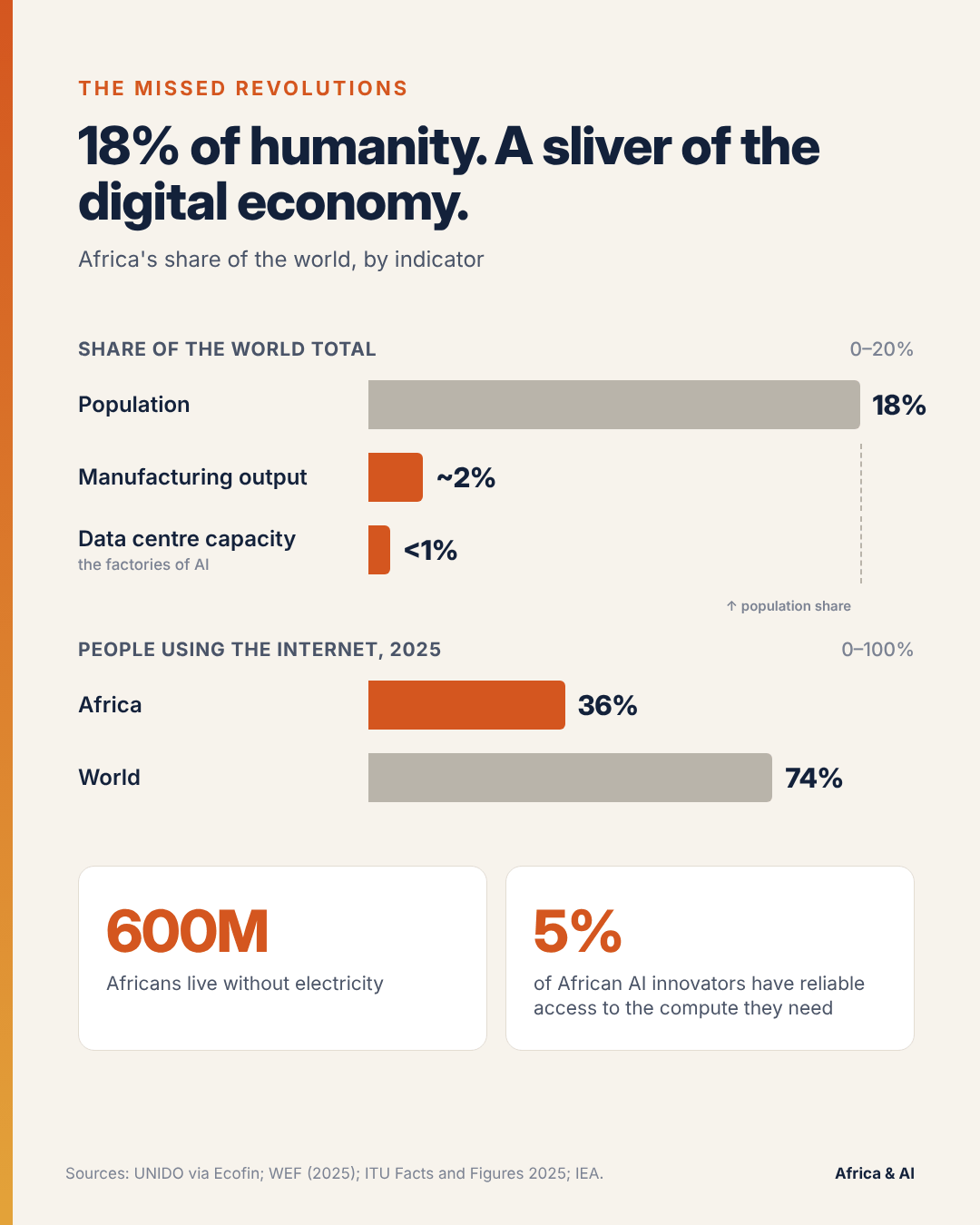
The first industrial revolution ran on steam, the second on electricity, and the third on computing and the internet. Each time, Africa entered late — mainly as a supplier of raw materials and a consumer of finished products. Value was created elsewhere.
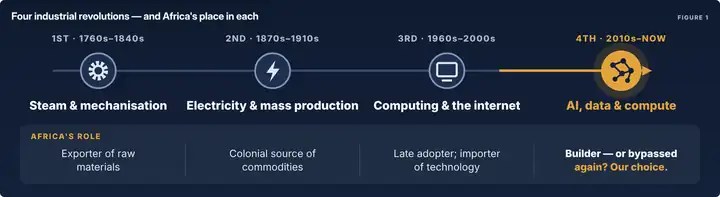
The numbers show how little of the industrial and digital economy the continent holds today. Africa is home to about 18% of the world’s people, yet it accounts for about 2% of global manufacturing output4 and under 1% of global data centre capacity.7 Around 600 million Africans live without electricity,5 only 36% were online in 2025 against 74% globally,6 and more than 400 million people in sub-Saharan Africa have no legal proof of identity.8
The opportunity this time is large. The World Economic Forum estimates that AI could add $1.2–1.5 trillion in economic value to Africa by 2030 — if the continent solves its compute gap. Yet only about 5% of Africa’s AI innovators have reliable access to the computing power they need.7
So my question to fellow policymakers is simple: can we afford to be trapped in a doomsday conversation when our institutions still lack the infrastructure, talent and capital needed for basic digitisation? The journey runs from digitisation to digitalisation, to digital transformation, and finally to AI transformation. Many of our systems have not yet completed the first step.

03 · Will AI wipe out humanity? History says we regulate, not retreat
Can Africa afford the doomsday narrative? My answer is no — and I do not believe AI will wipe out humankind. Every powerful technology has arrived with fear. Each time, humanity responded with rules, not retreat.
Cars
When self-propelled road vehicles appeared in Britain, the Locomotive Act of 1865 limited them to 4 mph in the country and 2 mph in towns. A person had to walk at least 60 yards ahead carrying a red flag. By 1896 the law was replaced and the limit rose to 12 mph.9 Society chose to manage the machine, not ban it.
Elevators
Early lifts terrified people, because a snapped rope meant death. In 1854, Elisha Otis demonstrated a safety brake at the New York Crystal Palace that stopped the car if the rope failed. Three years later, the first passenger safety elevator opened in New York.10 Without that brake, there would be no skyscrapers.
Trains
Early railways faced fierce public anxiety about speed and safety. Signalling, brakes, timetables and inspection made rail one of the safest ways to travel.
The lesson is clearest on our own roads. Africa has about 3% of the world’s vehicles, yet more than 300,000 people die in road crashes on the continent every year. Africa’s road death rate is about 26 per 100,000 people, against a global average of about 18 and under 10 in Europe.11 Yet nobody argues that cars will wipe out humankind. We respond with traffic rules, speed limits, a minimum driving age, and laws against driving under the influence.
We did not ban cars. We adopted them and wrote customized rules. This is how Africa should view, deploy and govern AI.
K.Dandajena (2026)
Accountability, not alarm, is how we make AI safe. That is fully consistent with the Secretary-General’s call that life-and-death decisions must stay with humans.
04 · Four system problems AI must help Africa solve
Africa’s real AI challenge is not rogue machines. It is systems that are not yet optimal or efficient enough to serve 1.5 billion people. Four stand out.
1. Public sector systems are old, siloed and not fit for AI
Many government services still run on paper, disconnected databases and legacy software that cannot share data. With more than 400 million people lacking legal identity and only a handful of countries offering working digital ID,8 an AI system cannot serve a citizen the state cannot see. Interoperable digital public infrastructure — identity, payments and data exchange — is the foundation for AI-enabled public services.
2. Health systems do not deliver access, affordability and availability
Africa’s health systems are not designed to reach anyone, anywhere, at any time. In 2024 the WHO African Region had only 46% of the health workers it needs and still faces a shortfall of about 5.85 million workers by 2030 — while 943,000 trained health workers were unemployed.12 Of the roughly 260,000 women who died from pregnancy and childbirth worldwide in 2023, about 70% were in sub-Saharan Africa.13 AI-supported triage, diagnostics, supply chains and workforce planning can help close the gap.
3. Education is not producing talent for the Fourth Industrial Revolution
About 89% of African children cannot read and understand a simple text by age 10, and Africa’s child population is projected to reach 580 million by 2030.14 Without strong foundational learning, digital skills and AI literacy, we will train consumers of AI, not creators of it. Adaptive learning, teacher support and skills-matching platforms are where AI can make the biggest early difference.
4. The digital foundations are thin
Energy, connectivity, compute, talent and capital are the factories of the AI age. With 600 million people off the grid,5 under 1% of global data centre capacity, and only 5% of AI innovators with reliable compute,7 Africa must build these foundations — and finance deep-tech ventures that remain starved of capital.


05 · From communiqués to working systems
Africa should not spend its limited time and capital chasing the doomsday debate. That debate is a distraction from the real task: building frontier, integrated systems that turn our many decisions, declarations, policies and communiqués into results for Agenda 2063.
The policy direction already exists. In July 2024, the African Union endorsed its Continental Artificial Intelligence Strategy — a strategy I had the privilege of drafting. It calls for AI that is African-led, development-focused and responsibly governed.15 What we need now is execution. Five priorities stand out:
- Build the foundations first. Treat energy, broadband, data centres and shared compute as AI infrastructure, and finance them as such.
- Make public systems interoperable. Invest in digital ID, data exchange and payment rails so that services can be joined up and AI layered on top.
- Start where lives are at stake. Deploy and evaluate AI in maternal and newborn care, diagnostics and supply chains, where gains in access, affordability and availability are greatest.
- Grow African talent. Fix foundational learning, and scale digital and AI skills in schools, universities and the public service.
- Govern like road safety, not like a siege. Adopt risk-based rules, testing and clear accountability, so that innovation and protection grow together.
The world is right to ask how AI should be held accountable. Africa’s contribution to that conversation is a reminder: the greatest risk for a continent of 1.5 billion people is not that AI will be too powerful, but that its benefits will once again be built, owned and enjoyed somewhere else.
We cannot miss a fourth revolution. Africa’s priority is not to fear AI — it is to adopt, adapt and build with it.
K. Dandajena (2026)

About the author
Dr Kudakwashe Dandajena is Principal Programme Officer for Technology Strategy at the African Union Development Agency (AUDA-NEPAD). He holds a PhD in Computer Science, specialising in the optimisation of AI algorithms and frameworks, and brings more than 16 years of experience leading global and continent-scale digital platforms across Africa. He contributed to the African Union Continental Artificial Intelligence Strategy (2024) and the STISA-2034 Implementation Plan, represents the African Union on the G20 digital track, and serves as a GPAI expert advisor to G20 and OECD countries on responsible AI. He is the architect of sovereign-grade digital public infrastructure deployed across the 55 AU Member States and more than 60 countries — including Africa’s supercomputers, data centres, manufacturing plants for smart devices, and safety surveillance platforms for medical products that drove a 15-fold increase in Africa’s reporting to the WHO global database, VigiBase. He has led programmes, projects and investments worth more than US$500 million. A published AI researcher and faculty member, he is a trusted CTO-level adviser to AU Member States and institutions, governments, regulators, development partners, multilateral organisations and private sector leaders.
Dr Kudakwashe Dandajena, Ph.D.
Principal Programme Officer, Technology Strategy
Head of South-South Cooperation & Development · Head of Health Data, Digital Systems & Innovation
Human Capital, Social and Institutional Development Directorate, AUDA-NEPAD
Email: kudakwashed@auda-nepad.org · kudadandaz@gmail.com
The views expressed in this article are the author’s own and do not necessarily reflect the official position of AUDA-NEPAD or the African Union.
References
- Brussels Morning, “Guterres warns world faces four tests of power”, September 2026. brusselsmorning.com
- Al Jazeera, “UNGA 81: Five key takeaways from general debate”, 29 September 2026. www.aljazeera.com
- Center for AI Safety, “Statement on AI Risk”, May 2023. aistatement.com
- Ecofin Agency, “Africa’s manufacturing sector grows, but global share stays small”. www.ecofinagency.com
- International Energy Agency, “New IEA report lays out pathway to finance universal electricity access in Africa”. www.iea.org
- The Guardian Nigeria, “Only 36% of Africa connected”, citing ITU Facts and Figures 2025. guardian.ng
- World Economic Forum, “Investment in green computing can unlock $1.5t in Africa”, December 2025. www.weforum.org
- Biometric Update, “2.8B still excluded from digital ID”, on World Bank ID4D data, September 2026. www.biometricupdate.com
- Wikipedia, “Locomotive Acts”. en.wikipedia.org
- Wikipedia, “Elisha Otis”. en.wikipedia.org
- Associated Press, “Africa has the worst road safety record in the world”, citing UNECA and WHO. www.smdailyjournal.com
- WHO Regional Office for Africa, “Africa’s health workforce expands but shortages, unemployment and migration intensify”. www.afro.who.int
- World Health Organization, “Maternal mortality” fact sheet. www.who.int
- Brookings Institution, “To prosper, Africa’s children and youth must learn”. www.brookings.edu
- African Union, “Continental Artificial Intelligence Strategy”, July 2024. au.int


Leave a comment